




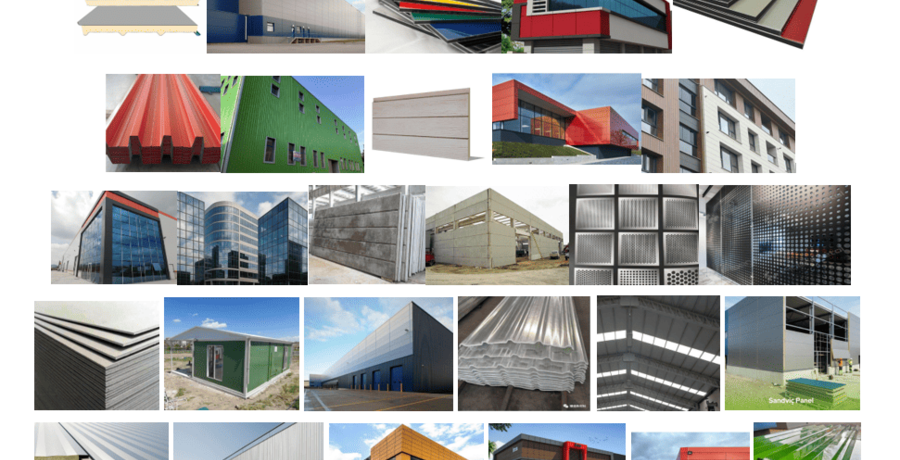
1. What is a Sandwich Panel? Advantages of Using Sandwich Panels in Industrial Buildings
Sandwich panels are modern building materials used in many different structures, from industrial facilities to warehouses, factories to logistics centers, providing thermal insulation and structural efficiency. Generally consisting of an insulation core placed between two metal surfaces, sandwich panels offer durability, energy efficiency, and quick assembly advantages in roof and facade cladding applications. Produced in different thicknesses, surface coatings, and insulation materials according to the requirements of the project, these panels are among the important product groups of the industrial building sector today.
One of the main reasons for choosing sandwich panels is that they help to improve the thermal insulation performance of buildings. Panels selected with appropriate properties can contribute to maintaining a more balanced indoor temperature, helping to reduce the energy consumption of heating and cooling systems. This feature is particularly important for large-scale production facilities, cold storage warehouses, food processing areas, and logistics centers.
Another advantage of sandwich panels is that they allow for the covering of large surfaces in a short time. Compared to traditional construction methods, the shorter assembly time can provide advantages in terms of labor planning and project schedule. In addition, their production in specific sizes at the factory can facilitate material management during application and, with proper project planning, can contribute to reducing material losses.
When selecting sandwich panels, only the external appearance or thickness of the product should not be evaluated. The type of insulation core, thermal conductivity value, fire reaction performance, coating properties of the metal surface, connection details, and the conditions of the environment in which it will be used should be considered together. For example, the technical specifications of polyurethane or PIR core panels and mineral wool filled panels are different. The appropriate product should be determined in line with expectations for fire safety, acoustic performance, and thermal insulation.
In roof applications, rainwater drainage, slope, connection points, and sealing details are prominent, while in facade applications, wind load, external environmental conditions, surface durability, and architectural appearance become important. Therefore, considering the project technical specifications in sandwich panel procurement is important in order to direct the right product to the right application area.
INDASTRIALS B2B Distributorship aims to meet the needs of manufacturers, contractors, building material wholesalers, project companies and international buyers by offering solutions for wholesale product supply in the field of industrial building materials.In addition to sandwich panels, support is also provided in the supply processes for composite panels, trapezoidal sheets, fiber cement panels, and other exterior cladding products.
- Composite Panels and Fiber Cement Panels: Modern Facade Cladding Solutions
Composite panels and fiber cement panels are important building materials used in modern architecture for exterior cladding, industrial buildings, commercial structures, and various architectural projects. Both product groups are preferred to improve the aesthetic appearance, performance against external environmental conditions, and functionality of buildings thanks to their different technical characteristics and application methods.
Composite panels are produced by combining different layers depending on the product type. Aluminum composite panels, in particular, consist of a core layer located between two aluminum surfaces. Thanks to their lightweight structure, smooth surfaces, and various color and surface options, they are widely used in commercial buildings, shop facades, office buildings, and corporate architectural projects.
Architectural design flexibility is an important factor in the preference for aluminum composite panels. Thanks to different colors, metallic surfaces, and various visual options, buildings can be given a modern look. However, technical specifications such as panel thickness, aluminum layer thickness, core type, fire performance, and assembly system must be suitable for the project. Especially in high-rise buildings and projects where fire safety requirements are present, the product should be selected in accordance with the relevant legislation and technical specifications.
Fiber cement panels, on the other hand, are structural panels produced using cement-based components and fiber reinforcement. Depending on the product formulation and production technology, they can be used in exterior cladding, partition walls, eaves, and various architectural applications. Designed to withstand humidity and external environmental conditions, fiber cement products, with proper detailing and installation, can help create long-lasting building solutions.
One of the important features of fiber cement boards is their ability to adapt to architectural projects with different surface and texture options. Various alternatives are available, from surfaces resembling wood texture to smooth and modern designs. However, the humidity conditions, freeze-thaw effects, connection system, and application requirements specified by the manufacturer at the place where the product will be used should be taken into consideration.
When choosing between composite boards and fiber cement boards, the area of use, building height, supporting substructure, weight, fire performance, maintenance needs, and total application cost should be evaluated. Neither product group may be a direct alternative to the same application; the right choice depends on the technical and architectural needs of the project.
INDASTRIALS B2B Distributorship supports businesses in the product research and procurement processes they need in the wholesale supply of building materials such as composite boards and fiber cement boards. For building material distributors, construction companies, facade application companies, project contractors, and importers, determining product specifications, researching suitable supply options, and planning international trade processes are important.
- Trapezoidal Sheet Metal, Perforated Sheet Metal, and Betopan: Sheet Systems Used in Industrial Buildings
Sheet products such as trapezoidal sheet metal, perforated sheet metal, and Betopan are among the building materials used in industrial buildings, roofs, facades, partitions, and architectural applications thanks to their different technical properties.Although these products may not be of the same material type or intended for the same use, they can fulfill important functions in industrial facilities, commercial buildings, warehouses, and various construction projects.
Trapezoidal sheets are generally produced by shaping galvanized or painted metal sheets into a specific profile form. The trapezoidal form increases rigidity depending on the geometric structure of the sheet and provides ease of use in covering large surfaces. Trapezoidal sheets used in roof and facade applications can be preferred in different structures such as factories, agricultural buildings, warehouses, workshops, and logistics facilities.
When selecting trapezoidal sheets, properties such as sheet thickness, profile height, metal type, galvanizing coating, paint system, and corrosion resistance should be evaluated. The product will be used as a load-bearing element.
In these cases, opening distances, loads, connections, and structural calculations should be determined by experts. Also, since trapezoidal sheet metal alone does not always provide sufficient heat and sound insulation, it can be applied with additional insulation layers according to the project’s needs.
Perforated sheet metal is a product obtained by processing metal sheets with holes in a specific pattern and dimensions. The diameter, shape, spacing, and open area ratio of the holes can vary depending on the intended use. Perforated sheet metal can be used in ventilation panels, machine guards, filtration systems, architectural facades, sunshades, safety elements, and decorative applications.
One of the significant advantages of perforated sheet metal is its ability to maintain the functional properties of the metal surface while allowing air passage or light transmission to a certain extent. However, the hole geometry, sheet thickness, material type, and assembly method can affect the product’s durability. In outdoor applications, corrosion resistance and surface treatments suitable for environmental conditions should also be considered.
Betopan, on the other hand, is known as a trade name used for sheet products where cement and wood-based components are combined. The exact composition and performance of the product may vary depending on the manufacturer and product series. These types of panels can be used in exterior cladding, partition walls, structural elements, and various industrial applications in suitable systems.
When selecting Betopan or similar cement-based panels, thickness, density, suitability to moisture conditions, mechanical strength, fire performance, and connection details should be examined. Performing cutting, assembly, jointing, and surface coating processes in accordance with the manufacturer’s technical instructions is crucial for the performance of the application.
Since these product groups meet different needs, the intended use should be clearly defined during the procurement process. For example, trapezoidal sheet metal might be considered for covering a large warehouse roof, while perforated sheet metal might be preferred for an application requiring controlled air and light passage in an architectural facade. Cement-based panels, on the other hand, can meet different cladding and partitioning needs in suitable building systems.
INDASTRIALS B2B Distributorship aims to provide supplier research and commercial coordination support for businesses wishing to procure trapezoidal sheet metal, perforated sheet metal, Betopan, and similar industrial building materials wholesale. For project-based purchases, regular wholesale orders, and export-oriented product demands, determining the correct product specifications, researching reliable supply sources, and planning logistics requirements are crucial.
- Facade Glass Cladding and Prefabricated Concrete Panels: Building Systems for Large-Scale Projects
Facade glass cladding systems and prefabricated concrete panels are two different building solutions used in commercial buildings, offices, industrial facilities, and large-scale architectural projects. Glass cladding systems offer transparency,While utilizing daylight and providing a modern architectural appearance, prefabricated concrete panels can offer advantages in terms of strength, mass production, and planning of assembly processes.
Exterior glass curtain wall refers to the assembly of glass panels on the exterior of a building through special carrier systems. In these systems, glass panels are supported by aluminum profiles or different carrier elements suitable for the project. It is frequently preferred in office buildings, shopping malls, hotels, business centers, and modern commercial structures.
The performance of glass curtain wall systems does not depend solely on the appearance of the glass. The thermal transmittance value of the glass, solar energy transmittance, light transmittance, safety features, and profile system are also important factors.
Sealing elements and assembly details should be evaluated together. Especially in structures with large glass surfaces, solar control and thermal insulation can affect the building’s energy performance.
Wind load, water tightness, air permeability, and connection safety are also important technical criteria in glass curtain wall systems. Before application, a suitable system should be designed taking into account the building height, facade geometry, and local climate conditions. The type and thickness of the glass should be determined in accordance with relevant safety standards and project calculations.
Prefabricated concrete panels are concrete structural elements that are produced in a facility environment, transported to the construction site, and installed in the structure using a determined assembly method. They can be used in factory walls, warehouse structures, commercial buildings, industrial facilities, and various large-scale projects. Controlled production conditions allow for monitoring of production quality and more planned execution of construction site work.
The dimensions, thicknesses, concrete class, reinforcement arrangement, surface properties, and connection details of prefabricated concrete panels are determined according to the project requirements. During transportation, the dimensions and weight of the panel, lifting points, and assembly equipment at the construction site should be taken into consideration. The transportation and lifting of large-sized elements must be carried out by expert teams with appropriate safety procedures.
Although prefabricated concrete panels and glass curtain wall systems have different functions, they can be used together in some projects. For example, opaque prefabricated concrete facade elements can be preferred in certain parts of an industrial building, while glass curtain wall systems can be preferred in the entrance or office sections. In such applications, architectural integrity, energy performance, connection details, and structural safety should be planned together.
INDASTRIALS B2B Distributorship supports businesses in researching products and suppliers suitable for their needs for the wholesale supply of product groups that can be used in large-scale construction projects. Identifying products suitable for project requirements and coordinating the supply process is an important need for construction companies, facade application companies, project contractors, building material distributors, and international buyers.
- Roof Lighting Panels: Polycarbonate and Fiberglass Roof Systems
Roof lighting panels are translucent or light-transmitting structural elements used to allow natural daylight to reach the interior sections of buildings. These panels, particularly preferred in factories, warehouses, workshops, greenhouses, agricultural facilities, and logistics centers, can help reduce the need for artificial lighting during daylight hours with appropriate design and application.
Polycarbonate roof panels are manufactured from a thermoplastic-based material. Depending on the product type, they can be flat, corrugated, or multi-layered. Their light weight and light transmittance make them a popular choice.This makes them suitable options for various roof lighting applications. However, the product’s impact resistance, UV protection, fire performance, thickness, and behavior against temperature changes vary according to product specifications.
Fiberglass roof lighting panels are generally manufactured from glass fiber reinforced polyester-based composite materials. Models designed to be compatible with corrugated metal roof systems can be used to support the entry of natural light into the roofs of certain industrial buildings. Light transmittance, outdoor resistance, resin properties, and UV protection should be considered in these products.
When selecting roof lighting panels, light transmittance alone should not be considered. Thermal insulation, condensation risk, sealing, fasteners, wind and snow loads, fire safety, and compatibility of the panel with the existing roof system should also be taken into account. Especially in large roof areas, the placement of lighting panels should be planned to help distribute natural light evenly throughout the interior.
The contribution of these products to energy efficiency depends on the building’s use and design. Maximizing daylight can reduce the use of electric lighting; however, solar radiation can also increase heat gain in the interior. Therefore, in hot climates or facilities with high cooling needs, light transmittance and solar control should be considered together.
The correct installation of roof lighting panels is critical for long-term use. Appropriate fasteners and sealing elements should be used at the joints with metal roof coverings, expansion movements should be taken into account, and the manufacturer’s installation instructions should be followed. Incorrect application can lead to problems such as water leaks or panel damage.
INDASTRIALS B2B Distributorship supports businesses in the wholesale supply of various industrial building materials, including polycarbonate and fiberglass roof lighting panels. Researching the products needed for factory, warehouse, logistics center, agricultural facility, and commercial building projects and evaluating suitable supply options are important stages in B2B purchasing processes.
- Wholesale Building Materials Supply and Export Solutions with INDASTRIALS B2B Distributorship
For businesses operating in the construction and industrial building sectors, obtaining the right material with the correct technical specifications and suitable supply conditions is of great importance. Especially in product groups such as sandwich panels, composite panels, trapezoidal sheet metal, fiber cement boards, exterior glass curtain wall systems, prefabricated concrete panels, perforated sheet metal, Betopan, and roof lighting panels, accurate planning of the supply process contributes to the efficient execution of projects.
INDASTRIALS B2B Distributorship aims to develop solutions for the building material needs of businesses by operating with a focus on wholesale sales, import, export, and supply coordination. Our business model is geared towards businesses that purchase wholesale rather than retail, distributors, importers, exporters, construction companies, contractors, and corporate clients that make project-based purchases.
In the first stage of the supply process, the product group and technical requirements needed by the customer are determined. Information such as product dimensions, thickness, material type, surface properties, insulation values, relevant standards, and order quantity are important for researching the right product. Sharing the technical specifications of the project,It facilitates the evaluation of alternative products and a more accurate comparison of supply options.
In the second stage, suitable manufacturer and supplier options are researched. If necessary, alternative products and supply sources are evaluated to determine the options that meet the customer’s needs. Technical documents, quality standards, production characteristics, and delivery conditions of the products are fundamental elements that should be examined before ordering.
In international trade, logistics planning is as important as product supply. Order quantity, product dimensions, packaging, loading method, type of transport, delivery point, and foreign trade documents should be taken into account in planning the shipment process. This is especially true for long or heavy construction materials.
Transportation costs, loading conditions, and the protection of products during transport should also be evaluated.
INDASTRIALS B2B Distributorship aims to support customers in stages such as product research, supplier coordination, bidding processes, and logistics organization planning for wholesale supply requests for domestic and international markets. Proper commercial coordination between buyer and supplier in import and export processes can help orders proceed in accordance with requirements.
Our product groups include sandwich panels, composite panels, trapezoidal sheets, fiber cement sheets, exterior glass curtain wall systems, prefabricated concrete panels, perforated sheets, Betopan, and roof lighting panels; these materials can be evaluated according to the needs of different construction projects. Product selection is based on intended use, technical specifications, order quantity, and delivery conditions.
Due to our pricing policy, product prices are not published on our website. Wholesale purchase requests are evaluated based on the product’s technical specifications, order quantity, delivery address, and logistics requirements. Therefore, businesses wishing to receive a price quote need to fill out the request form for the relevant product, specifying their needs and contact information.
As INDASTRIALS B2B Distributor, our goal is to facilitate the building materials procurement processes of businesses, to research suitable product and supply options, and to contribute to the development of sustainable business relationships in domestic and international trade.