




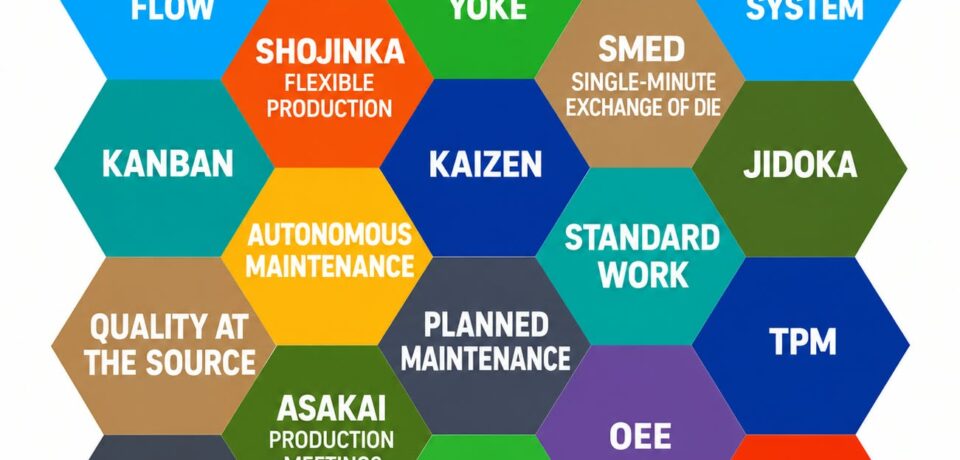
In logistics operations, efficiency doesn’t just mean working faster. Organizing workflows, reducing unnecessary movements, controlling errors and waste, supporting employee safety, and creating a culture of continuous improvement are fundamental parts of the lean approach.
Lean Training at Industrial Logistics aims to provide employees with a practical perspective that enables them to evaluate daily operations more systematically and more easily identify improvement opportunities.
6S
6S is a lean management approach that aims to make workspaces more organized, clean, standardized, and safe. It is created by adding a safety dimension to the steps of sorting, organizing, cleaning, standardizing, and sustainability. 6S applications in warehouse and logistics areas can help make it easier to access the necessary equipment, reduce unnecessary movements, and create more controlled workspaces.
Kaizen
Kaizen is based on systematically making small but continuous improvements instead of large, one-off changes. It is important for employees in logistics operations to recognize the problems and improvement opportunities they encounter in daily processes. Small improvements, such as shortening order preparation time, reducing material movements, or making a work step more practical, can turn into significant operational gains over time.
Ergonomics
Ergonomics encompasses the arrangement of the work environment and work methods in a way that is suitable for the physical characteristics of humans. Lifting, carrying, bending, reaching, or repetitive movements for extended periods in warehouses can create physical strain on employees. Ergonomics training aims to make more informed assessments of issues such as working height, material placement, handling methods, and workstation layout.
FIFO
FIFO – First In, First Out is a stock management approach based on the principle that the first product to enter the warehouse should be the first to leave under appropriate operational conditions. Especially for products where shelf life, production date, or stock age is important, the correct application of the FIFO system helps in managing stocks more effectively. The training covers how product placement, inventory tracking, and operational flow can be organized in accordance with the FIFO principle.
Feedback
Feedback is an important tool for the sustainability of a lean management culture. Employees’ ability to openly share problems, risks, or improvement suggestions they observe during operations contributes to the improvement of processes. Effective feedback means not only pointing out the error but also understanding the cause of the problem and supporting the creation of a better working method.
Kanban
Kanban is one of the lean management tools that supports the visual tracking of workflows and material movements. It can make it more visible which tasks are pending, in progress, or completed in warehouse, supply, and operations processes. A properly used Kanban system can help reduce excess inventory, make it easier to track needs, and identify bottlenecks within operations.
Brainstorming
Brainstorming is a participatory method that allows teams to develop different perspectives on problems encountered and generate numerous solution ideas in a short time. It can be used to evaluate the causes of issues such as delays, errors, waste, quality problems, or inefficiencies in logistics and operations processes and to identify opportunities for improvement. The aim of these studies is to collect ideas without limiting them in the initial stage, then to identify feasible suggestions and transform them into concrete actions.
Quality Control
Quality control encompasses monitoring the conformity of a product or service to specified requirements throughout the process. In logistics operations, problems such as wrong products, damaged packaging, incorrect quantities, missing labels, or incorrect shipments can create additional costs and time losses. Quality control should be addressed not only at the end of shipment but also at different stages, from receiving and warehousing to order preparation and loading, to help detect errors earlier.
Just in Time
Just in Time is an approach that aims to ensure that the required product or material is available at the required time and in the required quantity. While aiming to reduce space, financing, and management costs created by holding excess inventory, it is also necessary to maintain supply continuity. Therefore, in Just in Time applications, it is important to consider demand, lead time, inventory level, and operational planning together.
Near Miss
Near misses refer to events that have the potential to turn into accidents, even though no injury or material loss occurs. Examples of near misses include a falling material in a warehouse not hitting an employee, a collision between a forklift and a pedestrian narrowly avoided, or the detection of a load with a risk of tipping over. Recording these events and investigating their causes can help prevent more serious occupational safety incidents in the future.
7 Basic Wastes
In lean management, the 7 basic wastes are one of the fundamental concepts that make it easier to identify activities that do not create value. Unnecessary transportation, excess inventory, unnecessary movement, waiting, overproduction or preparation, unnecessary processing, and rework due to errors can manifest in different forms in logistics operations.The training aims to enable employees to recognize these wastes in their own work areas and evaluate daily operations from this perspective.
Action
The true value of the lean approach emerges when identified problems are transformed into concrete actions. Identifying a problem alone is not enough. The work to be done, the responsible person, the targeted result, and the follow-up process must be clarified. Regularly monitoring the actions, evaluating the results of completed work, and determining new measures when necessary ensure the continuity of the continuous improvement process.
Lean Training in Logistics with Industrials
Indastrials, within the scope of Lean Training in Logistics for logistics, warehouse, operations, and supply chain teams, addresses 6S, Kaizen, ergonomics, FIFO, feedback, Kanban, regin waste, quality control, Just in Time, near miss, 7 basic wastes, and action management topics by relating them to the daily operations of businesses.
The training content can be planned according to the participant profile and the needs of the business. The aim is not only to learn lean management concepts, but also to enable employees to more consciously evaluate losses, risks, and improvement opportunities in their own work areas.
For detailed information about Lean Training in Logistics, corporate training content, participation conditions, and training planning specific to your company, you can fill out the form below. The Indastrials team will evaluate your training needs and contact you about training options suitable for your company’s operational structure.
To receive detailed information about participation requirements and training planning tailored to your business, please fill out the form below. The Indastrials team will evaluate your training needs and contact you regarding training options suitable for your company’s operational structure.To receive detailed information about participation requirements and training planning tailored to your business, please fill out the form below. The Indastrials team will evaluate your training needs and contact you regarding training options suitable for your company’s operational structure.